If you’ve ever spent any time observing a house cat, you know they’re creatures of habit, small spaces, and mysterious little rituals that seem to make zero sense to humans. As someone who’s been designing and building cat houses for over a decade, I’ve fielded more questions from customers than I can count—none more persistent than this: Do cats actually prefer cat houses with multiple entrances? Cat House
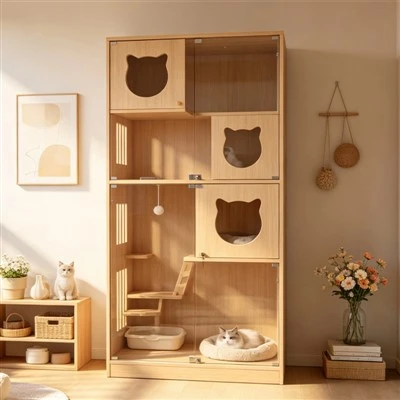
The short answer, after years of testing, watching, and even failing a few times (RIP the batch of single-entrance cottages we made in 2019 that sat in our warehouse for 18 months), is yes. But not just because cats like extra doorways. There’s a whole mix of feline behavior, evolutionary instinct, and silly little quirks that drive this preference, and it’s not just about adding more holes to a box.
Let’s start with what we know about how cats evolved, because that’s where most of their weird little likes and dislikes come from. Domestic cats are descended from African wildcats, tiny hunters that hid in rocky crevices and dense underbrush to stalk prey and avoid becoming prey themselves. For those wild ancestors, having more than one entrance to a hiding spot wasn’t a luxury—it was a survival tool. If a larger predator wandered past the only entrance, the wildcat could bolt out the back and escape. That instinct hasn’t gone away, even for a tabby that only hunts dust bunnies in your living room.
Early on, we thought we were building the perfect cat house: a cozy, insulated wooden box with a single entrance, just big enough for a cat to squeeze through, lined with soft fleece, and placed in a quiet spot away from foot traffic. We’d test them with our own office cats first, and they’d sniff it, maybe curl up for 10 minutes, then abandon it for a random cardboard box under the desk. It took us a while to notice the pattern: the cardboard box under the desk had a gap at the side we hadn’t noticed, a tiny second entrance that let the cats slip in without being front-and-center for whoever was walking by.
We redesigned that first failed model to add a second, smaller entrance on the opposite side of the house, and suddenly our office cats were camped in it for hours. But it wasn’t just two entrances we were seeing. We started testing three-entrance models with a few foster cats we worked with, and the shyest of the foster kittens spent more time in those than any other house we provided. They’d slip in one entrance, peek out another, and bolt through the third if a dog walked by the foster room. That’s when we started digging into research to confirm what we were seeing in our own small test group.
A 2018 study from the University of Lincoln’s Cat Behaviour and Welfare Research Centre found that cats are significantly less stressed when they have multiple escape routes available in their resting spaces. The study monitored 50 domestic cats over eight weeks, placing identical houses in their homes—half with one entrance, half with two. The cats in the two-entrance houses showed lower levels of cortisol (the stress hormone) in their fur, and were less likely to avoid the house entirely when other pets or people were around. The lead researcher, Dr. Sarah Ellis, noted that for cats, being able to rest without feeling “cornered” is one of the biggest factors in choosing a safe space. That makes total sense when you think about how often cats freeze or bolt when they think there’s no way out.
But it’s not just about escape routes. Cats are also territorial creatures, and multiple entrances let them use their house in different ways depending on their mood. Some days, a cat will want to use their house as a private den—they’ll use the main entrance and ignore the other one. Other days, they’ll use a side entrance to sneak in and out, especially if there are other cats in the home. We’ve seen this with multi-cat households that have purchased our houses: the new cat uses the hidden side entrance to avoid the resident cat’s dominance displays, and the resident uses the main entrance to mark their space without feeling like they’re intruding on the newcomer.
We also learned something else from watching our customers: not all multiple entrances are created equal. We used to make both entrances the same size, and we noticed that larger cats (like Maine Coons) would use the big one, while smaller cats or kittens would use the smaller side one. But when we started making our standard model with one 8-inch main entrance (big enough for most adult cats) and one 5-inch side entrance, we saw that even single-cat households would use both. It’s like having a front door and a back door for your cat—they can choose how they want to interact with their space that day.
Another quirk we’ve picked up over the years: cats love being able to “survey” their space without being seen. A second entrance gives them a spot to peek out at the yard or the living room without sticking their whole head through the main door. We’ve had customers tell us their cats will nap in the house, but every few minutes, they’ll slip over to the side entrance and just sit there, watching the birds at the feeder. For a cat, that’s the perfect balance of safety and entertainment—they’re hidden, but they can still keep an eye on what’s going on around them.
Now, we’re not saying single-entrance cat houses are useless. If your cat is the only pet in the home, very shy, or only uses small spaces for short naps, they might be perfectly happy with a simpler design. But from our experience (and the research we’ve referenced), multiple entrances offer a level of flexibility and security that most cats respond to, regardless of their age, breed, or personality.
Over the years, we’ve also adjusted our designs based on feedback from customers and our own hands-on testing. We add removable liners that fit through either entrance, so it’s easy to clean regardless of how your cat uses the house. We make the entrances slightly angled, so they don’t look like open doors that would make a cat feel exposed. We even add a tiny third entrance, usually at the top of the roof, for cats that like to climb and survey their space from above—though that’s a more popular add-on for kittens and high-energy cats than older, more sedentary ones.
One of my favorite stories from a customer came last year from a family with a 12-year-old tabby named Mochi. They had two single-entrance houses that Mochi had ignored for years. They bought one of our two-entrance houses on a whim, and within a week, Mochi was sleeping in it every night. Their follow-up email said, “We thought she just hated houses, but it turns out she hated not having a place to escape if the dog wanted to play with her. Now she uses the back door to sneak out to the patio when she’s had enough of us.” That’s the kind of feedback that makes all the trial and error worth it.
At the end of the day, cats don’t care about sleek design or fancy features—they care about feeling safe. A cat house with multiple entrances isn’t just a novelty; it’s a space that lets them be themselves, whether that’s curling up for a nap, sneaking around to avoid other pets, or keeping an eye on the squirrel that taunts them from the tree outside. If you’re in the market for a new cat house, whether for one cat or a whole household, it’s worth considering adding that extra entrance. We’ve spent years perfecting these designs, and every time we see a cat curl up in one of our houses, we know we got something right.
If you’re looking to stock up for your shelter, boutique, or multi-cat home, we’d love to chat more about our designs, customization options, and bulk pricing. Feel free to reach out to us to learn how we can help you provide the safest, most comfortable spaces for the cats in your care.
Commercial Furniture References
Ellis, S. L. H., et al. (2018). The effect of resource design on feline stress levels and house use in domestic cats. Applied Animal Behaviour Science
Bradshaw, J. W. S. (2016). The Behaviour of the Domestic Cat. CABI
McConnell, P. B. (2019). The Other End of the Leash: Why We Do What We Do Around Dogs and Cats. Ballantine Books
Wenzhou Mu Jia Furniture Co., Ltd.
As one of the most professional cat house manufacturers in China, we’re featured by quality products and low price. Please rest assured to buy cheap cat house in stock here and get free sample from our factory. We also accept customized orders.
Address: 4th Floor, Building 1, Oufei Intelligent Manufacturing Base, Yongxing Subdistrict, Longwan District, Wenzhou City, Zhejiang Province
E-mail: tao850322@163.com
WebSite: https://www.cnmujia.com/
